What is Influence360?
Influence360 is an AI growth platform for Web3, built on the creator economy. At its core is a live global marketplace where projects hire vetted KOLs directly, fund campaigns through on-chain escrow, and see which creators, languages, and channels actually drive results. The KOL marketplace is live and audited today, with PR, performance marketing, UGC, and a premium analytics layer on the roadmap. The same rails are designed to extend into gaming and AI next.
In short: one place to decide where your growth spend should go, execute across every channel, and pay with trust built in.
Why we built Influence360
Web3 marketing has no central place — and no brain.
Running one serious campaign today means stitching together five or more separate vendors: KOLs through agencies, PR over wires, quests on another platform, deals in Telegram, payments OTC. Every vendor reports differently, so nothing is comparable, nothing is attributed, and nothing is learned for next time. Worse, payments usually go out upfront with no escrow and no recourse — in our own survey of creators, a majority reported having done work they were never paid for.
The result is spend decided by gut instead of data, impressions chased instead of conversions, and no system telling you where the next dollar should actually go. We built Influence360 to close that gap: connect the intelligence to the execution, put both on rails that protect everyone, and let projects and creators meet directly.
How does the Influence360 marketplace work?
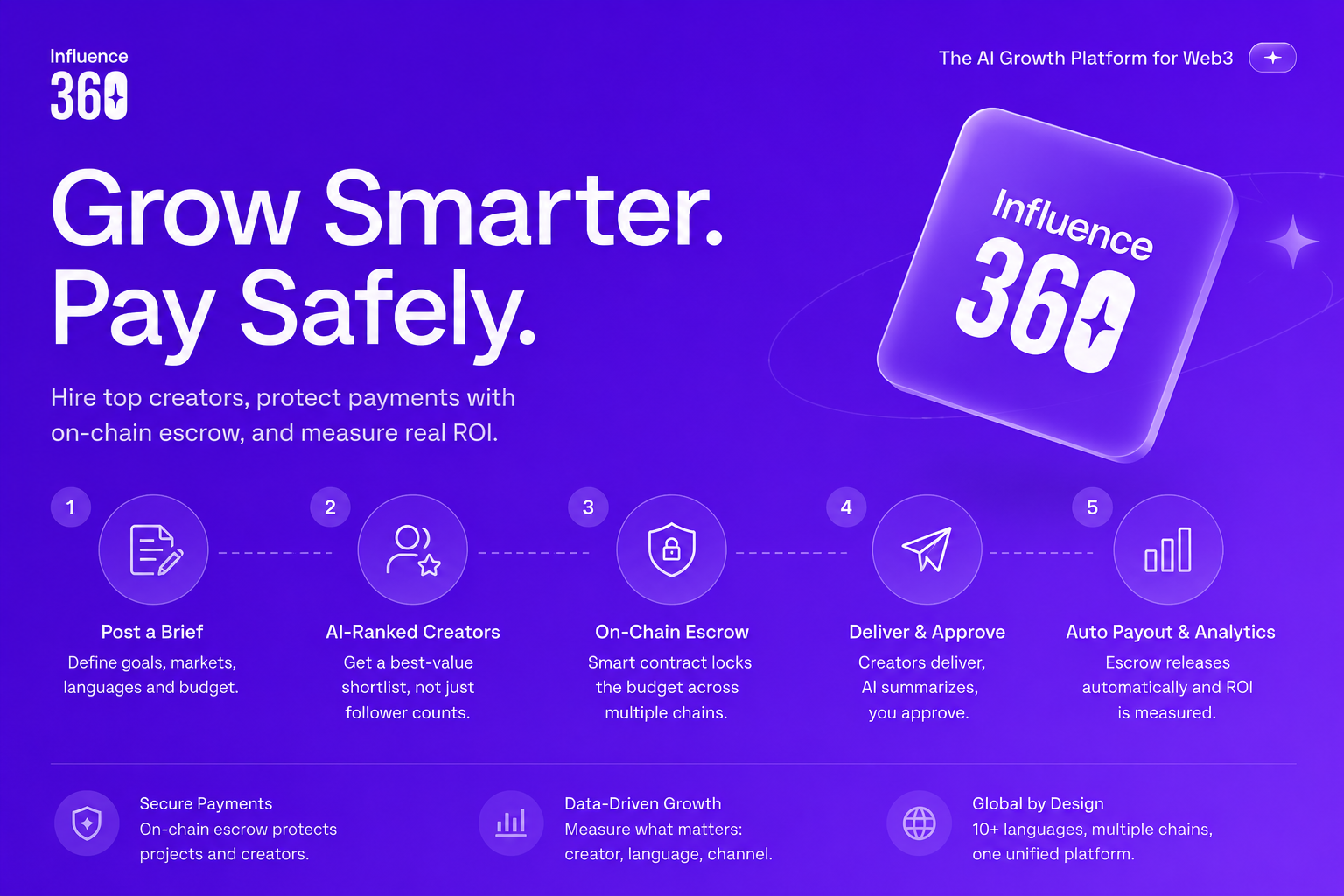
The live product is a global KOL marketplace that runs in five steps:
Post a brief. Define your goals, markets, languages, services, and budget.
Get a ranked shortlist. Applicants are ranked by a best-value score, so you're choosing on evidence, not follower counts.
Fund escrow. A smart contract locks the budget — one campaign or many in a batch.
Deliver and approve. Content links come in with AI summaries, and you approve the work.
Auto payout. Escrow releases on approval, and analytics rank the ROI.
The whole flow is built for global campaigns — 10+ languages across West and Asia, managed from one dashboard — with escrow protection across most EVM chains, Solana, and Tron, so creators can be paid in your token or a stablecoin.
What makes Influence360 different?
Most tools in this space solve one piece. Some own the data but can't execute. Some own execution but have no data. Influence360 is built to connect the two:
Direct, data-ranked hiring. Projects and creators connect directly, with applicants ranked by a best-value score instead of raw reach.
On-chain escrow. Funds are locked in a smart contract and release on approved delivery — across multiple chains — protecting projects from non-delivery and creators from non-payment.
Analytics tied to spend. Performance is measured against the campaign, so you learn which creator, language, and channel actually drove ROI.
AI woven through. AI ranks applicants, summarizes deliverables, and is being built to draft briefs and flag underperformance.
Who is Influence360 for?
The platform serves every side of Web3 growth:
Companies and projects that need to reach a real, relevant audience across global markets — and want to verify performance, not guess at it.
KOLs and creators who want to work with projects directly, get verified, set their own rates, and get paid reliably through escrow.
Media outlets looking to connect with projects for transparent, escrow-backed placements as the PR module comes online.
What's live now, and what's next
The KOL marketplace is live and audited today — projects can post briefs, hire vetted creators, and pay through on-chain escrow right now, with 250+ verified KOLs across multiple chains.
From here, the platform expands into a unified growth OS: a PR module for tier-1 and tier-2 media, performance and affiliate marketing, UGC and short-form clips, and a premium analytics layer that turns social, on-chain, and narrative data into a clear read on where you stand and what to do next. Looking further out, the same escrow and ranking rails are designed to serve gaming creators and the emerging class of AI-product creators — categories that face the exact trust and attribution problems we're solving in Web3 first.